Growth & Sales
From Views to Sales: What Should a Development Project Measure?
Reach, views, clicks, and leads tell us how communication is performing. But for a development business, the more important question is different: how does attention turn into real demand, and how does demand turn into sales?
Buying real estate is not a single action. Customers move through a process in which information search, financial assessment, consultation, project visits, and the final decision are interconnected.
In Zillow’s 2025 study of U.S. home buyers, for example, 80% identified contacting an agent as one of their first three actions in the buying process, 55% cited getting pre-approved for a mortgage, and 51% mentioned viewing a property in person. In the same study, 79% of buyers used a real estate app.
These figures relate to the U.S. secondary housing market and cannot be directly applied to development sales. But they illustrate one important point: the real estate customer journey consists of several interconnected stages.
A Lead Is Not Yet Demand
A form submission, phone call, or message is an important signal, but not every lead has the same value.
One customer may simply be asking about the price.
Another may be interested in a specific apartment. A third may already have the financial capacity to purchase. A fourth may be planning to make a decision several months from now.
Without understanding these differences, evaluating marketing purely by lead volume can be misleading.
That is why it is important to see the stages that follow:
Interest → Qualified Demand → Consultation → Visit → Offer → Decision → Sale
This is not a universal funnel formula — the specific stages should be defined according to each project’s sales model.
Financial Readiness Is Part of the Customer Journey
In Zillow’s 2025 prospective buyers’ study, 73% of prospective U.S. buyers planned to finance their purchase with a mortgage or another type of home loan. Of those, only 28% had received pre-approval, while 52% said they had paused or postponed the buying process at least once in order to save enough for a down payment. The study included more than 18,100 prospective buyers.
These figures relate specifically to the U.S. financial system and U.S. consumers. However, they highlight a broader business issue:
Interest and actual readiness to purchase are not the same thing.
A sales system should therefore know not only “Who is interested?”, but, where possible, “At what stage of the decision-making process is this person?”
Marketing and Sales Data Need to Connect
If the marketing team sees clicks and leads while the sales team sees calls, visits, and contracts – but those datasets are not connected – valuable information is lost.
A campaign may generate inexpensive leads, but very few of them may progress to a sale.
Another campaign may generate fewer leads, but bring in higher-quality demand.
The first may look better in an advertising dashboard.
The second may be better for the business.
This is where CRM becomes more than a contact database – it becomes a decision-making tool.
The Right Metric Depends on the Business Objective
Not every project needs the same KPIs.
At the launch of a new project, rapidly generating market interest may be important.
At another stage of construction, the priority may be increasing qualified demand.
For a project with a large inventory, the objective may be to support the sale of specific unit types.
For another project, it may be re-engaging customers and accelerating decision-making.
That is why asking “How many leads did we get?” is not enough.
More useful questions are:
Where did the demand come from?
Which audience actually progressed to the next stage?
Which product generates more interest?
Where does the customer journey break down?
And which actions generate real business results?
Data Should Not Only Describe the Past
A good measurement system is not simply a report prepared at the end of the month.
Its value lies in using the information we gain to change the next decision.
If demand for a particular apartment type is high, that information matters to sales.
If customers repeatedly ask the same question, it matters to communication.
If many leads are lost at the same stage, it matters to process design.
If a particular audience converts better, it matters to media optimisation.
Data becomes valuable when it feeds back into action.
SECTOR VIEW
For SECTOR, growth does not begin with an advertising dashboard and does not end when a lead is generated.
We see it as one connected chain:
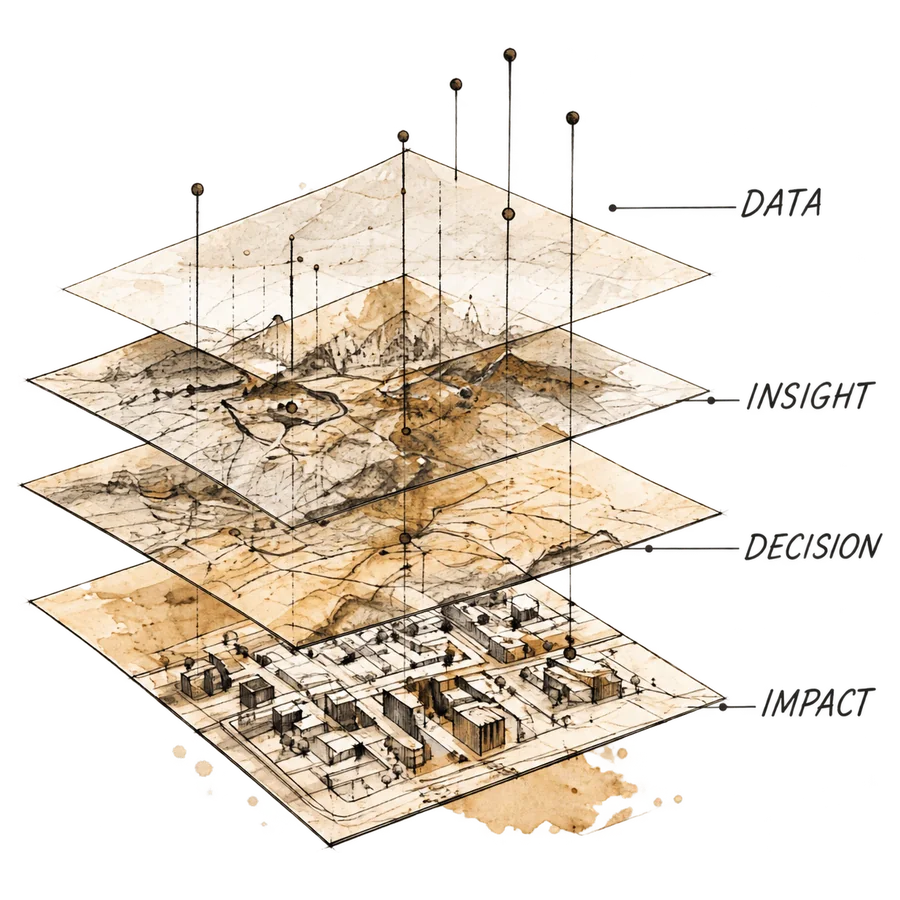
Attention | Interest | Demand | Sales Process | Conversion | Business Result
But there is one more important step:
The knowledge gained from business results needs to flow back into the system.
Sales data can change marketing.
Customer questions can change communication.
Demand patterns can influence pricing or product decisions.
That is why, for SECTOR, Growth is not simply about generating more traffic or more leads.
Growth is a system that shows us not only what happened, but why it happened – and what we should do next.
Sources
Zillow Research — Buyers: Consumer Housing Trends Report 2025
Zillow Research — Prospective Buyers: Consumer Housing Trends Report 2025
Zillow Research — Affordability Metrics Methodology
More Insights
Market & Trends
The Rules of the Real Estate Market Are Changing
In 2025, global real estate investment transaction volumes increased by 14%, reaching $888.6 billion. PwC and the Urban Land Institute’s 2026 global outlook sees this as a sign of market recovery. Yet the broader picture presented by the same report is even more interesting: the market is gaining momentum, but it is not returning to the old rules.

Strategy & Brand
A Good Project Is Not Always a Strong Brand
Architecture, location, and product are the foundations of a project. But if their value is not translated into clear positioning and a consistent experience, the market may not perceive the project the way the developer intended.
Architecture & Product
Product Comes Before Marketing
The positioning of a development project does not begin with a campaign. Apartment size and layout, shared spaces, infrastructure, natural light, and everyday comfort already create the value that the brand and marketing must later be able to communicate.

Communication & Content
More Content Does Not Always Mean More Communication
Real estate buyers today have access to more information than ever before. This means that a project’s challenge is no longer simply visibility. What matters is how quickly and clearly customers can understand what the project offers and why it matters to them.