Market & Trends
The Rules of the Real Estate Market Are Changing
In 2025, global real estate investment transaction volumes increased by 14%, reaching $888.6 billion. PwC and the Urban Land Institute’s 2026 global outlook sees this as a sign of market recovery. Yet the broader picture presented by the same report is even more interesting: the market is gaining momentum, but it is not returning to the old rules.
What is defining this new reality?
01 – Efficiency Is Now a Strategic Issue
JLL’s 2026 global outlook identifies efficiency as one of the key forces shaping commercial real estate. Rising construction, energy, and operating costs are forcing projects to manage both investment and day-to-day operations with greater precision. In JLL’s survey of experts across 37 markets, 88% expected construction or fit-out costs to increase in 2026 – 69% anticipated a moderate increase, while 19% expected a significant one.
For developers, this means efficiency is no longer simply about reducing costs. Decisions about product, space, pricing, technology, and operations need to work within a single business logic from the outset.
02 – Lower New Supply Is Increasing the Importance of Quality
According to JLL, the pipeline of new projects had already been declining across many developed markets due to high construction and financing costs. Additional cost pressures in 2026 have reinforced this trend, contributing in some markets to a shortage of high-quality new space and a widening gap between prime and secondary assets.
PwC/ULI’s U.S. research reveals another interesting contrast: among 27 property subcategories, the investment outlook improved for 16 in 2026, while the development outlook declined for 18. These are assessments by U.S. respondents rather than global market statistics, but they illustrate an important tension: interest in real estate can increase even as developing new projects becomes more difficult.
03 – Consumers Are Evaluating More Than Square Metres
Experience is playing an increasingly important role in real estate value.
In JLL’s Future of Work 2026 survey, 62% of organizations prioritize building quality and amenities over a prime location, while 66% prefer AI-enabled buildings to those with basic building management systems. These figures relate specifically to commercial real estate and workplaces and should not be directly applied to the residential market. However, they clearly indicate that functional quality, experience, and technological capabilities are becoming increasingly important factors in user decisions.
For SECTOR, there is an important connection here: experience does not begin with communication. It must be built into the product.
04 – The AI Conversation Is Moving Toward Specific Use Cases
AI is no longer only a topic for the future of real estate, although adoption remains uneven.
In Deloitte’s 2026 Commercial Real Estate Outlook, 19% of respondents say their organizations are still at an early stage of the AI journey, while 27% face technical challenges, a lack of relevant expertise, or resistance to change during implementation. Deloitte particularly emphasizes the importance of reliable data and technological readiness.
In Europe, adoption is accelerating. According to PwC/ULI’s Emerging Trends Europe 2026, 75% of respondents report using AI or machine learning in their real estate activities, compared with 51% the previous year. This figure relates specifically to the European survey.
The question, therefore, is becoming less about “Are we using AI?” and more about “Which decisions does it help us make better?”
05 – Real Estate Is Becoming Increasingly Connected to Technology and Infrastructure
One of the developments highlighted in 2026 research is the growing convergence of real estate and infrastructure. In PwC/ULI’s global study, data centers are identified as one of the major opportunities across all three regions – the Americas, Europe, and Asia-Pacific. At the same time, their development depends on access to land, energy, and water and requires significant capital expenditure.
This does not mean that trends affecting data centers should be directly applied to residential development. The broader shift is more important: real estate value is becoming increasingly dependent on the systems to which an asset is connected – energy, technology, data, and infrastructure.
SECTOR VIEW
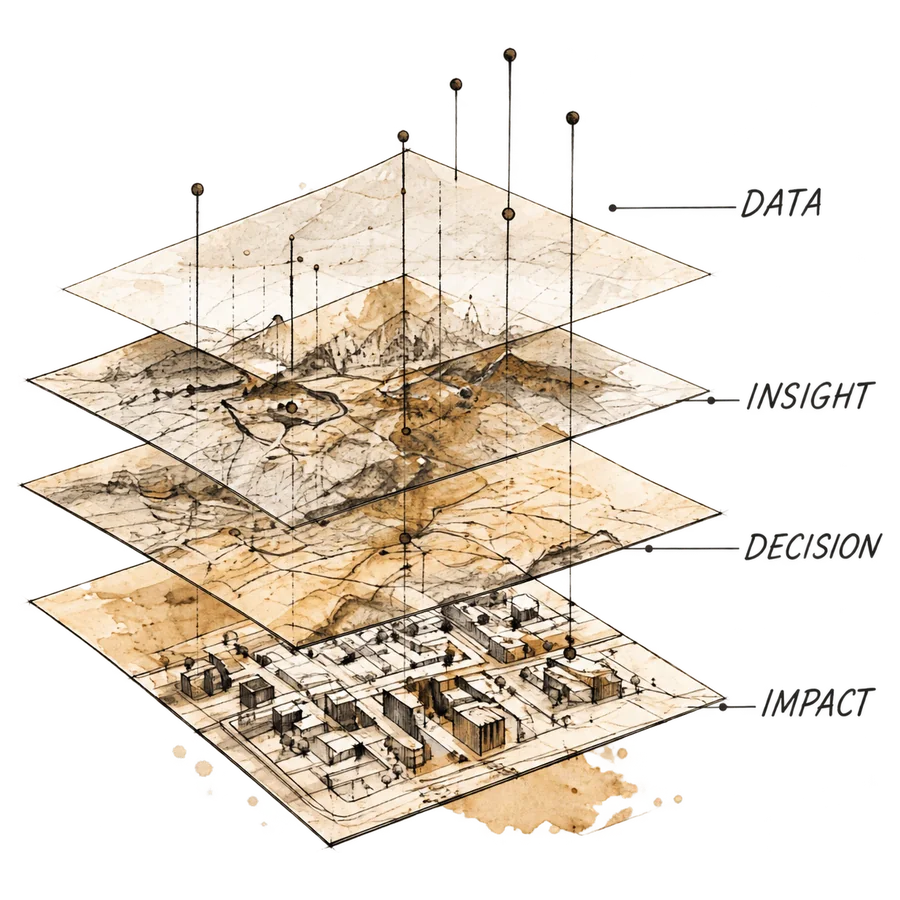
One common pattern emerges from the 2026 landscape: a development project can increasingly no longer be viewed as a collection of independent decisions.
Market research influences the product.
The product influences positioning.
Positioning influences brand and communication.
Communication influences demand.
And data should improve decision-making at every stage.
This is why, in modern real estate development, competitive advantage is often created not by one strong component, but by the way all components work together.
This is also the SECTOR approach: knowledge is not simply about collecting information. Its value emerges when research becomes the right decision, the decision becomes action, and the action becomes a measurable business result.
Sources
PwC & ULI — Emerging Trends in Real Estate: Global Outlook 2026
JLL — Global Real Estate Outlook 2026: Mid-Year Update
Deloitte — 2026 Commercial Real Estate Outlook
PwC & ULI — Emerging Trends in Real Estate: Europe 2026
PwC & ULI — 2026 Property Type Outlook, U.S. & Canada
More Insights

Strategy & Brand
A Good Project Is Not Always a Strong Brand
Architecture, location, and product are the foundations of a project. But if their value is not translated into clear positioning and a consistent experience, the market may not perceive the project the way the developer intended.
Architecture & Product
Product Comes Before Marketing
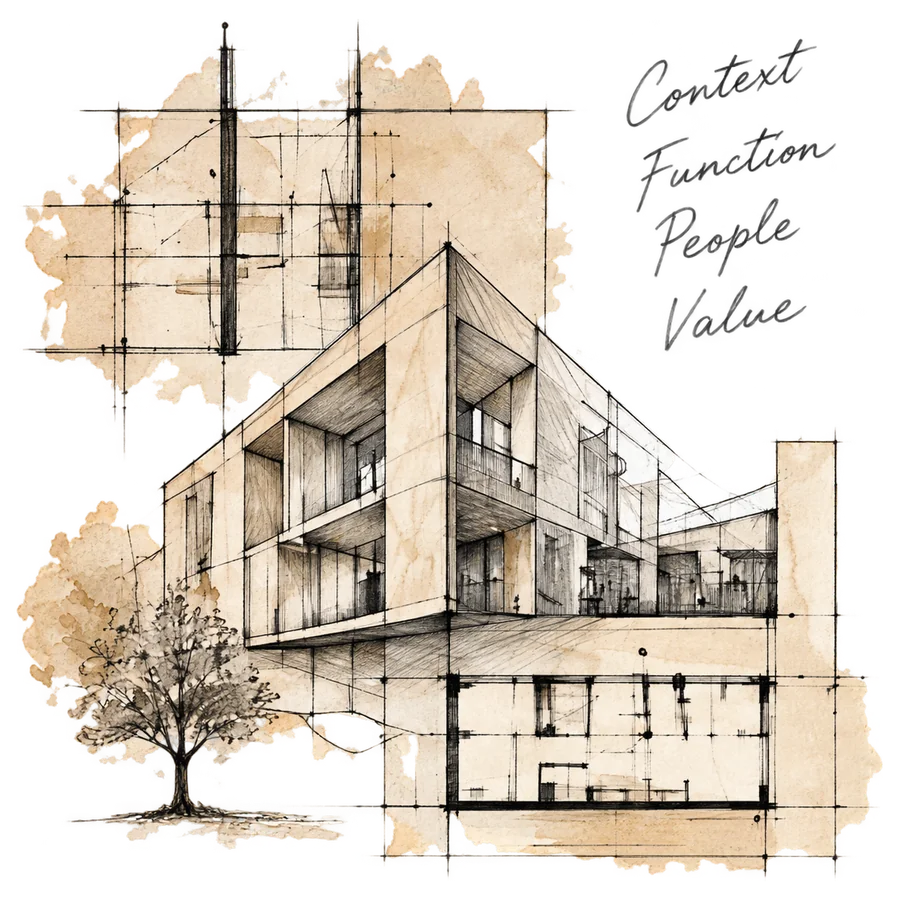
The positioning of a development project does not begin with a campaign. Apartment size and layout, shared spaces, infrastructure, natural light, and everyday comfort already create the value that the brand and marketing must later be able to communicate.
Communication & Content
More Content Does Not Always Mean More Communication
Real estate buyers today have access to more information than ever before. This means that a project’s challenge is no longer simply visibility. What matters is how quickly and clearly customers can understand what the project offers and why it matters to them.
Growth & Sales
From Views to Sales: What Should a Development Project Measure?
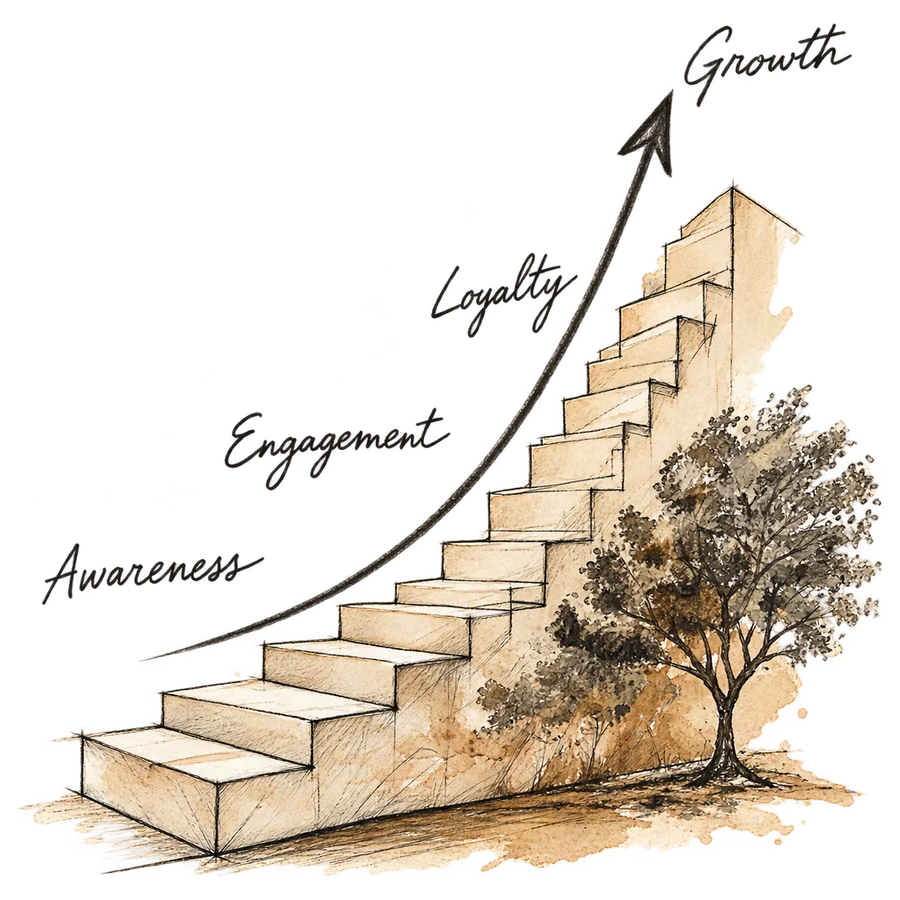
Reach, views, clicks, and leads tell us how communication is performing. But for a development business, the more important question is different: how does attention turn into real demand, and how does demand turn into sales?